

Shovel People by Asya Graf
Today, a rainy winter Sunday, I’m sitting cross-legged on my bed in Brooklyn, my grandparents’ letters spread out around me, decades of dispatches from their ordinary Soviet lives washed up here like kelp after a storm. Since inheriting them after my grandma’s death three years ago, I’ve been reading them obsessively, excessively. Sometimes just smelling them is enough. Today I’m distracted, reading and also watching live coverage on a loop: an endless parade of people inching up the road to Borisovskoye Cemetery in southeast Moscow. They carry heaps of flowers and bright yellow rubber ducks. I wish I were there with them, in the city where I was born, with the only kind of Russians I seem to like anymore: those who won’t be silenced.
Today is February 16, 2025, the one-year anniversary of Alexei Navalny’s murder in a remote Arctic penal colony. The only way I know how to pay my respects is to watch every video I can find from today’s procession, and also from Navalny’s funeral last year, when the line to his grave stretched over three kilometers long. I can’t stop looking at close-ups of the protesters’ faces, these mourners, the ones who are smiling and the ones who are crying, and others who look at the camera with a kind of defiance.
Spontaneously, the crowd breaks out into chants of gratitude: spa-si-bo! spa-si-bo! Or hope for the future: Russia will be free! Russia without Putin! I get chills when the chant flickers with anger: Ne prostím! “We won’t forgive.” Sometimes they just chant Na-val’-nyi. Na-val’-nyi, the word that has come to contain all the other messages. I’m floored by their boldness, given the risks. We don’t have much experience in Russia, Soviet or not, with direct expressions of opposition—and the few instances of protest have come at immense personal cost to the participants. In 1968, in a now famous protest of the Soviet invasion of Czechoslovakia, eight brave women and men turned up for a peaceful sit-in at Red Square, including the poets Natalya Gorbanevskaya and Vadim Delaunay. “For your and our freedom,” one of the signs they held read. All but one of the eight were shipped off to labor camps or psychiatric prisons.
I’m envious of the moral courage and clarity of Soviet and now Russian dissent. It’s February 2025, after all, just short of a month since the inauguration here in the United States, three months since the election. And I’m still unsure how to act, aside from the habit I’m forming of calling my representatives’ offices, leaving them scripted messages that feel both urgent and inane. The people lining up with flowers in Moscow have far more reason to feel the futility of their actions, and yet they look determined, festive, sorrowful. They are not resigned; they seem clear. They are risking far more than I would ever dare risk. I don’t know what it’s like to turn up to a protest that could end with a ten-year sentence in a penal colony. If my family had never emigrated, I’m not sure I’d have the courage to be out there on the street in Moscow.
Which brings me to the reason why, today of all days, I’ve spread my grandparents’ letters out on my bed. I want their guidance, or something like it, some report of what it was like to live under a thoroughly authoritarian, violent regime and still retain a sense of normalcy, joy, and aliveness. Some humanity. Or else I want to know—and this is harder to admit—how not to act. I want to face my grandparents’ evasions, denials, and avoidances, to see the blind spots they couldn’t see. Not to judge them but because we, too, are neck-deep in evasions now, here, in order to live. I want to locate in my grandparents’ lives, and therefore in my own life, that thin edge between pleasure and joy on the one hand and conformity and forgetting on the other.
In his first 1962 letter to my grandma Sveta, my grandfather Yura describes the start of his summer geological expedition to the Soviet Far North, through the taiga of the Kola Peninsula and up to the Barents Sea. He then launches into a long apology for being “a bad husband and a bad father” and promises to do better. “The air here is so clear it’s like a filter, removing all the bad,” he writes. “I feel myself changing.” From these lofty confessions and promises, the tone and subject shifts to practical concerns: the projected dates of his return to Moscow in September, train schedules and itineraries, and speculations about Sveta’s and my then eight-year-old mom’s holidays.
Yura goes on to describe to his girls the beauty of the White Sea, where he swims in twelve-degree-Celsius water and spots ringed seals and a pod of beluga. “But I have to pack now, I’ll tell you more when I get back,” he says abruptly, and I want to pull him back and demand that he describe the taiga, its sounds of birdsong, its resiny, mossy smells, and the cold, white-capped sea, the way the cold feels on his skin, how he feels seeing beluga, sharing the water with them. And I have other questions for him about the land he travels over that have nothing to do with its natural history.
For the next year, my grandpa continues traveling to complete his dissertation. He records nothing of substance about his work in nuclear physics, since it was zasekréchena (classified, literally “secreted”). The towns where he conducted his research were mostly zakrýtye gorodá, closed cities, known only by number, their existence never officially acknowledged under the Soviet regime. With the help of a colleague heading back to Moscow, he manages to mail a letter from a nearby town—which is why, he tells my grandma, he doesn’t have to write about his research in code (“but in the future, Svetik, I’ll have to write to you about my work with hints and clues [ulíkami i namyókami]”). Yet the details he reveals when he has the chance, I’m disappointed to see, have nothing to do with his actual research. Instead, he describes his schedule, how late he’s stayed up working, when he has to get up tomorrow so he can jog before his next shift.
I don’t know how to read the meaning of his silences. I wonder if Yura was so well schooled in secrecy and the art of indirect speech that he couldn’t bring himself to divulge anything of importance, or if he just didn’t want to get into explaining nuclear physics to his wife in a letter. And even his acknowledgment of the required secrecy reveals nothing of how he felt about it. I’m aware of a wish, totally unreasonable, for my grandfather to find this requirement ridiculous, problematic, to subvert it in some way. But if I had to guess I’d say that he was at most mildly annoyed by the restriction, and not a little proud that his work merited the classified category.
The final letter of the series describes Yura’s extensive workout in another unnamed town—a long run on freshly fallen snow, followed by weight lifting at the gym, followed by a trudge to the cafeteria (“I barely made it!”). The apologies and pledges to my grandma continue. I have a feeling that my grandpa is relishing this role—the adventurer reporting in code on his travels and sending chivalrous messages to his girls at home. I see him as a young man high on the success of his research, excited to be moving through a silent winter forest, and also about returning home to his family. Nothing in these letters—how can it?—suggests any kind of reckoning with the historical, political reality of the early-1960s Soviet Union. To expect this from my grandparents’ letters—from the letters, that is, of ordinary Soviet people—is naïve and in many ways American. Resistance requires first the ability to notice that something is deeply wrong. Noticing takes an inner freedom that my grandparents either lacked or forgot how to use. Yet I worry that to leave it at that is to rush to exonerate them. I worry, too, that who am I to exonerate anybody, stuck, as I am, in my own doubts and hesitations about how to live noncompliantly in Trump’s America.
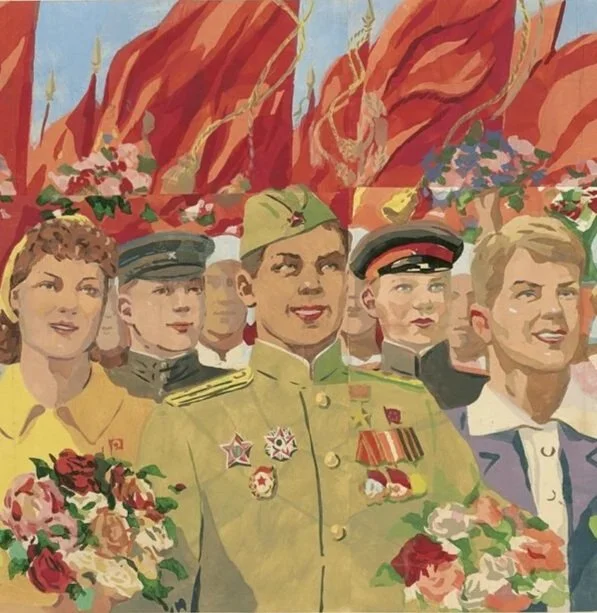
I think about my grandparents in the summer of 1962: thirty, at times ambivalent parents of an eight-year-old girl, having just barely averted divorce for reasons I’ll never know, my grandfather forging for himself a very Soviet career in science, the kind of science that built bombs, nuclear reactors, rocket engines. Running and swimming, winning medals, exploring the far reaches of the Soviet empire, conducting experiments in something to do with uranium (that much my grandmother knew), then sending letters home about it: this was the culture of my squarely Soviet family, at least on my mom’s side. Their evasions and everyday dissensions were also Soviet, no more or less than what average citizens allowed themselves. They were neither Party ideologues nor dissidents; their daily Soviet reality was simply normal, and they were normal people. In 1990s Russian slang, people like them might be labeled sovki, the plural of sovók. The “sov” comes from Soviet, but the word is also a pun on the Russian word savók, meaning shovel. So: a shovel person. Plain, workaday. A regular Soviet person who valued normalcy above all else.
And yet the land through which they moved and on which they lived was not normal. The Kola Peninsula my grandfather traversed in 1962 was a land scarred with uranium mines, with the recent deportations and forced resettlement of the seminomadic Saami people, and with towns and roads built by forced labor—the workers imprisoned in nearby penal colonies set up for this purpose. The White Sea Canal my grandpa likely crossed, completed in 1933 under Stalin, was designed and built entirely with forced labor: the first but far from last Soviet infrastructure project to earn this distinction. Inmates of the Gulag dug through the permafrost, dying of malnutrition and accidents. I imagine their bodies buried alongside the canal through which the Arctic Ocean now flows out to the Baltic Sea.
As I hold one of the letters, I realize that it was posted from about the same latitude as Polar Wolf—the penal colony where Navalny was murdered last year. Polar Wolf opened in 1963 on the site of a former Gulag prison. Millions of people had been freed just ten years earlier, upon Stalin’s death, and in the subsequent years of de-Stalinization. It didn’t take long to start filling the prisons again.
My grandpa’s ecstatic journey of self-discovery, his epiphanies and promises of reform as a husband and a father, his joy at swimming with seals and beluga, was set against the backdrop of violent repression, systematic enslavement of the population to provide a cheap labor force, and mass murder. On his way to the Barents Sea, Yura’s body moved through a land shot through with state-perpetrated violence against its people, and against the land itself. The markings would have been readable to someone who was willing and knowledgeable enough to read them. My grandpa was not. Most Soviets were not. Let me put it another way: my grandpa and millions like him chose not to be. It would not have felt like a choice to them, but it was. It is always a choice what we seek to know and what we’re willing to forget, unknow, or never become curious about in the first place. Or so I tell myself, wanting to believe that no authoritarian regime, no matter how violent, total, or lasting, is powerful enough to eradicate our curiosity and conscience.
If I sound harsh and unfair in tasking my grandparents with a choice they barely knew they had, it is not to judge them. I know how easy it is to live an ordinary life amid oppression that becomes woven into the fabric of every day and so starts to feel normal, unquestionable. If we believe a system, a law, a way of life to be unquestionable, that makes it so. I remember it from my Moscow childhood, the moment I first confronted the subtle clues that not all was normal: learning that my grandmother’s actual patronymic was never the Russian-sounding Semyónovna but actually Solomónovna; trying to understand why my grandmother’s brother, who immigrated to the United States in 1974, wasn’t able to come to visit us. Or why our American guests were allowed to shop at the foreign-currency store and we weren’t, or not officially—which opened up for me further questions about the limits of laws and the wisdom of breaking them. These incongruities were there for even a child to see, and yet the message was also clear: go on living with these dissonances, absorb them, then forget that you ever did. The prohibition goes deeper than don’t talk about it. It’s internal. Unsee what you saw, unknow. Split, dissociate, repress. Oppression necessitates repression if you want to live a normal life.
It’s as easy as it sounds in my grandparents’ letters to live a normal life under an authoritarian regime. You love or fall out of love, you go on summer adventures, defend a dissertation. The trains keep running, cows keep giving milk. You go for a jog, lift some weights, stumble into the cafeteria and devour your millet kasha, wash it down with scalding black tea. You take pleasant evening walks and stop by the post office to send your wife a letter scribbled on the back of a telegram form. Or, in my case, you watch your mom pay for jeans with US dollars and you stuff down the fear and smile at the sales lady just like an American would. You know to say nothing of your family’s plans to immigrate to America. Be silent as a partisan (molchí kak partizán), my grandma used to say with a wink, and I listened.
It doesn’t start out that way, though. When we’re first shoved under authoritarian rule, we feel overwhelmed, then helpless, then frozen, then the discomfort of this dissonance is too much, and here begins the forgetting. We begin to move through bloody, tortured landscapes, believing them to be beautiful, forgetting that there was anything to read. We forget how to read.
What if my obsession with rereading my grandparents’ letters has something to do with my refusal to forget, and my fear of forgetting? My refusal to become a shovel person.
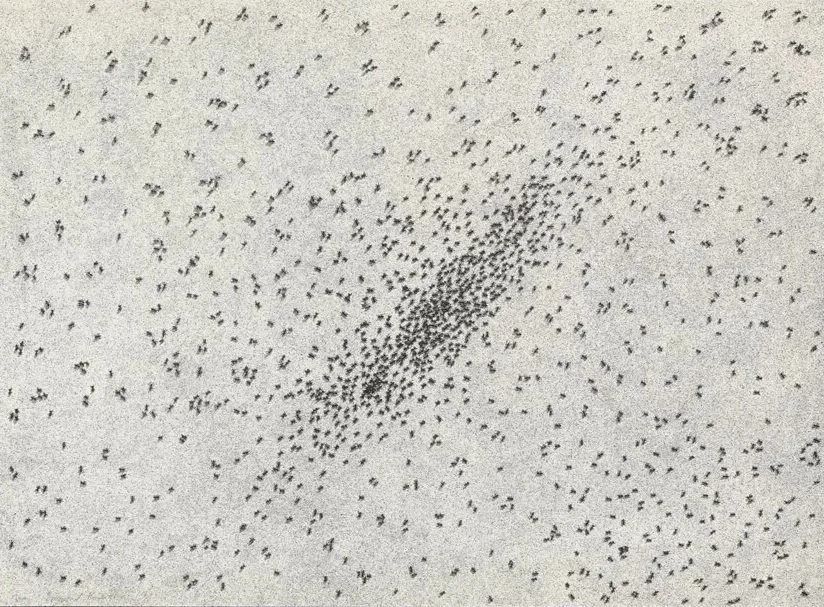
To a Russian speaker, the word sovók invokes a dull, blunted object, ordinary, clumsy, and useless. But, in fact, shovel people (and, for that matter, shovels) are very useful. They are the foundation on which an authoritarian regime is built.
The term “shovel person” comes from a more scientific-sounding name, as if a new species had emerged. It derives from Homo Sovieticus—the title of a 1982 novel by Alexander Zinoviev, a dissident who had to flee the country in order to freely diagnose it. The concept of this blunted, subservient person took on more heft when researchers set out to study it a few years later. In the hopeful perestroika year of 1987, the sociologist Yuri Levada and his colleagues conducted public-opinion polls to see whether Homo Sovieticus was alive and well after evolving for decades under Soviet rule, or whether it would expire with the country’s democratization. What defines a festive occasion for you? they asked. Do you prefer a boss who’s a Party member? Do you think homosexuals should be liquidated? The answers surprised them: the younger generation in particular wanted to party not on May Day or Victory Day but whenever they could get together with friends and drink. They didn’t much care if their boss was a devout Communist. And enough people seemed to believe that homosexuals should be either left alone or helped rather than liquidated. Based on these findings, Levada’s group concluded that both Homo Sovieticus and the Soviet empire itself were dying out, and would soon go extinct. (As I said, these were the hopeful days.)
As Putin launched his consolidation of power in the early 2000s, Russian sociologists had reason to revisit all this. This time, one of the original researchers, Lev Gudkov, defined Homo Sovieticus, it seems to me, with more compassion and nuance. His was less a condemnation and more an inquiry into this common personality shaped by the Soviet regime. He also found that shovel people were not, contrary to earlier findings, going extinct anytime soon.
Gudkov understood Homo Sovieticus as someone who has learned to exist in a state of “habitual, almost passive fragmentation,” as the Russian journalist and political analyst M. Gessen puts it. It is a person who has to think “different, often utterly contradictory things at different times and in different situations—whatever they needed to think in order to conform at that particular moment.” I think about the adaptiveness of such shape-shifting, its intuitive nature easy to grasp even for a child. I think about how I’d hear my grandma called Svetlana Semyónovna by my friends and their parents, while knowing and unknowing that this was not her real name. I think about how easy it was to say nothing about my grandma’s brother in America, which would give away both his Jewishness and his traitorousness. To call it secrecy would be to miss the point: I simply unknew that I knew this fact when the subject of America or Jews or emigration came up.
I know how alarmingly easy it is to become a shovel person. The greater compassion in Gudkov’s research, I imagine, stemmed from a realization that he was no longer labeling the ignorant, blinkered sovók who went the way of the USSR. Rather, he was coming to understand, in early 2000s Russia, just as we are in mid-2020s America, that the authoritarian subject is increasingly all of us.
The shovel person is not extinct. The personality did not die out with twentieth-century dictatorships—Soviet, capitalist, or otherwise. “Shovelthink” is what we all do sooner or later, to a lesser or greater extent, when we exist inside an authoritarian regime. We witness deportations of children sick with cancer or the refusal to let a family take their pregnant daughter off life support or the kidnappings of immigrants from their homes. And in response we become fragmented, we know the horror and disavow it, we normalize the unthinkable, find ways to minimize it, or else avoid thinking about it altogether. This fragmentation both within ourselves and between us and our fellow humans is precisely the aim of the authoritarian regime. “Rather than possessors of truths, we are to serve as lonely nodes in a power network,” the historian Timothy Snyder writes about the kind of subject these regimes seek to create. Our loneliness is their aim.
Today I’m lonely, in this month of too many anniversaries (one year since Navalny’s murder; three years since the full-scale Russian invasion of Ukraine; ten years since the murder of Boris Nemtsov, another charismatic Russian opposition leader; one month into the Trump regime), this month of too many sub-freezing days with gusting winds blowing down off the Canadian Arctic and straight through our windows. I keep poring over these letters from a country that should have taught us a lesson but didn’t—and when I say “us,” I mean us Russians, us Americans, us Westerners who would like to believe, despite all evidence to the contrary, that the underpinnings of our political systems are still largely democratic. I keep scrutinizing the actions of my grandparents, as though I could learn something from their adaptation to shovelhood.
And I keep reading—excessively, obsessively—analyses of the Trump coup, as well as explanations for why many of us are having a hard time wrapping our minds and hearts around the fact that a coup is possible in America. “[W]ith so much continuing normally, it’s easy to doubt what you’re seeing,” Joyce Vance, a former US Attorney in Alabama and a political analyst, writes. With so much continuing normally: my Soviet-born ears perk up at that word. Soviet reality was above all ordinary, normal, banal. To say everything is okay in Russian, you say everything is normal, vsyo normál’no. This was my grandmother’s favorite expression. So much so that when Parkinson’s dementia took away most of her ability to speak this phrase alone remained. She’d repeat it to herself, to us—a litany, a prayer, solace despite the self-deception.
Everything in my empirical world feels normal. I go to the doctor for my colonoscopy where we discuss, among other things, surfing and Nina Simone, whose voice is the last thing I hear before the anesthesia overtakes me. My partner picks me up, we stop by the bookstore on our way home to buy a book by a writer I love about her life with her partner on their own tiny island not far from my grandpa’s North Sea. We come home to work, I take a break to call my mom. At the same time, everything is falling apart, but I can only access this intellectually, theoretically, by reading the news. The disaster is disembodied—which is to say, I’m privileged enough to experience this disaster, so far, as disembodied. This is where doublethink begins—split, dissociate, repress. This is where we risk starting to say to ourselves, “Vsyo normál’no.”
After we came to the US, my mom used to say, “You can recognize a Russian from a mile away,” and she’d say it with a face like she’d just bit into a sour blueberry. We were in 1990s suburban Southern California, isolated from other Soviets, and I wondered at the time what her disgust meant, what those subtle clues were that she was reading and judging. Now I understand: the ex-Soviet neighbors I pass on my Brooklyn street, in the grocery store, give no hint of a smile, try as I might to entice them with my brightest California-girl hello. The mask remains firmly in place: corners of mouth turned down, eyes squinted at me like I’m a suspect in a lineup. So as not to despair and judge my people too harshly, I remind myself: this famous Soviet dourness is just the public face, the most visible symptom, of Homo Sovieticusness. I’m seeing the result of the spark extinguished. Of curiosity, vivaciousness, spontaneity, a basic trust and faith in the okayness of others—gone. This has taken a few generations to fully set in, but I’m afraid that it can go a lot faster—can happen in the span of, say, a four-year presidential term.
This is why I keep looking through photos of my grandparents, trying to discern whether the spark is still there in their eyes. If I were to meet them at the Uzbek supermarket as strangers, would they smile and say hello back? I’d like to say yes. In photos they’re smiling, especially my grandma, and their eyes are dancing, especially early in their marriage, which also coincided with the relative openness of the Khrushchev thaw years. They look alive and exhilarated when they’re out skiing on fresh snow, or running, or swimming—sports in my family, among its many other functions, was an antidote to the deadness. Not consciously, but still. We moved our bodies to stay sane, to stay ourselves. And if there was hope for them, several decades into the dictatorship in their country, surely there must be hope for us.
Something else, too, has helped keep that spark alive in my family, paradoxical as it may seem. As Soviet Jews who were not considered Russian, being other had its advantages, mostly of the spiritual-moral kind. As an ethnically non-Russian, you got to keep a little corner of freedom: you were forced to see what others didn’t. You’d be denied entrance to university, or be passed over for a promotion, or outright called a zhyd (a yid, but even harsher-sounding with the drilling zh) on the bus, and in that brief but lasting rent of pain and humiliation you’d see through to the other side. Or not exactly to the other side: you’d just see the whole thing as a fabricated stage set and you’d realize at some level that there is another side, that this whole reality isn’t normal. Of course, this wasn’t unique to Soviet Jews: ask a Chechen, a Tatar, a Kalmyk, or anyone who is both ethnically other on paper and looks it. Perhaps my grandparents and my parents, too, saw through this rent afforded by their otherness and so were able to notice that the entire structure was a flimsy construction. A glimpse that couldn’t be acknowledged, much less recorded in letters, but a subtle chipping away at their sense of normalcy nevertheless.
I cling to my otherness so that I don’t imagine myself safe. I keep smiling at the stone-faced Soviets at the market. I keep reading the news and letting the grief wash over me and spending every dinner with my wife analyzing the latest atrocities as though our ability to give them meaning could restore some sense of order. And then I run off to the ocean to swim, seeing and not seeing the plastic bottles and bags tangled up in the wrack line, noticing the persistent erosion of sand on the beach as the sea reaches ever higher.
Maybe I keep rereading my grandparents’ letters as a reminder to be compassionate—with them, with myself, with everyone. Their correspondence reminds me that this can happen, that the pull of the normal will come for me too, for all of us. And, when it does, I want to allow myself to temporarily dwell in the ease of the normal without succumbing to it fully. Without losing myself, or my ability to notice our own scarred landscape: more and more people with nowhere to shelter overnight except on the subway, smog hanging heavy and diesel-scented over the port, white cars with missing license plates that could be on their way to rip someone from their home. Maybe the choice isn’t between dissociated complicity or constant vigilance. Maybe it’s time for a new authoritarian subjectivity: something other than the shovel person. We will all have to learn what that is, together.
For now, I feel like a patient on the operating table fighting off the inevitable anesthesia. Don’t let me go to sleep.
Asya Graf is a writer, psychotherapist, and swimmer. Her essays and poetry have appeared in The Dodge, Queer Love Project, Gulf Stream, Cimarron Review, and Santa Fe Literary Review, among other journals. She has completed a memoir that reckons with her family’s inter-generational athletic passion. She’s working on a collection of essays documenting a swimmer’s-eye view of the climate crisis in the ocean and along her home coasts. Asya received a PhD in Comparative Literature from Princeton University and an MSW in clinical social work from Hunter College in NYC. She is a 2025 Lambda Literary Fellow and a 2025 Monson Arts writer-in-residence. She lives in Long Beach, CA with her wife.